
Instagram’s algorithm has become extremely sensitive to “inauthentic” engagement. Buying likes or follows is officially against Instagram’s guidelines and can trigger penalties. In fact, industry analysts note “no provider can make risk disappear” – even “safer” auto-like services carry compliance risks.
Both Meta and regulators are clamping down: Instagram now penalizes accounts using bots or fake engagement, and the U.S. FTC bans “fake or false indicators of social media influence”. The only truly safe growth is organic. Nonetheless, agencies and brands sometimes use third‑party tools to boost reach.
Below we compare two popular services – Azexo and Twicsy – focusing on their delivery methods, security features, and policy compliance.
Instagram’s algorithm rewards genuine, interactive content. Socialinsider data shows Instagram engagement has tightened (engagement down ~24% YoY), making authentic “double-tap” signals more critical than ever.
Marketers now emphasize meaningful formats (carousels, Reels) and early engagement velocity rather than pure volume. Both Azexo and Twicsy aim to jump-start a post’s initial metrics, but only the services that use gradual, realistic pacing and no credential-sharing can partially align with Instagram’s rules.
Azexo’s Data-Driven Engagement Platform
Azexo positions itself as a premium SaaS-style tool for agencies and e-commerce brands, emphasizing analytics and compliance. Its marketing and help pages repeatedly stress “no password required” and “Instagram-friendly” delivery. For example, Azexo’s free Instagram Views trial page explicitly assures users that:
- No Credentials Needed: You only provide a post link or account name, never your password. Azexo’s Live Follower Count tool similarly fetches data via Instagram’s public API: “No sign-ups, no passwords…100% Secure & Anonymous”.
- Algorithm-Friendly Delivery: Azexo claims to use a drip-feed model. High-retention “VIP” accounts (with complete profiles) watch your reel long enough to register as real engagement. Its trial promises 500 views arriving within ~60 seconds, then slowing to avoid a spike. Azexo touts that 85,000+ orders have been delivered with “no bans” by this method.
- Security & Privacy: All data is encrypted. Azexo warns “never give out your password” and markets itself as “100% safe”, promising zero risk of shadowban. Their refund policy backs this up: if Azexo fails to start a delivery on time (a technical glitch), they offer a full refund.
- B2B Focus: Azexo explicitly targets brands and agencies. Their pricing plans and dashboard cater to workflow-driven use (scheduling, caps, add-ons) rather than one-off buys. In a 2026 review of “top automatic likes services”, Azexo is listed first – a subscription/auto-detection tool with high automation and a dashboard for brands.
In short, Azexo is designed to look and feel like a legitimate marketing SaaS. It leverages data (e.g. its free Azexo’s Live Follower Count tool) to show transparency and avoids any credentials. Its model aligns with best practices (no bots, no passwords, gradual delivery) described by industry guides. It’s self-described as independent from Instagram (not affiliated with Meta), but it also highlights that independence as a safety feature.
Twicsy’s Services and Compliance Risks
Twicsy is a more mainstream “buy likes/follows” panel that markets low cost and speed. It claims all engagement comes from “real Instagram users – real people”, and like Azexo it never asks for your password. But Twicsy’s risk profile is very different:
- Delivery Model: Twicsy offers one-off packages (e.g. 10,000 likes) or subscription boosts, promising “Quick Results” within 24 hours. The process is one-step: you give your username, and Twicsy begins instantly. There is no drip-feed or pacing by default – likes/follows often flood in immediately.
- Claims of Authenticity: Twicsy emphasizes “no bots” and “real users”, but many user reports suggest large churn. Unlike Azexo, Twicsy does not highlight retention or quality. Its Terms of Service bluntly warn that its statistics are not guaranteed and that services are delivered as-is. In practice, customers often see follower counts drop back down as Instagram purges inactive accounts.
- Security: Like Azexo, Twicsy doesn’t require passwords. However, its own terms tell you everything about risk: Twicsy explicitly disclaims any affiliation with Instagram and states “you use Twicsy at your own risk”. (In contrast, Azexo portrays its lack of password as a safety feature.) If Instagram ban a client, Twicsy’s Terms deny all liability.
- Business Use Prohibited: Crucially, Twicsy’s Terms forbid commercial or agency use. It states: “If you are a business or acting on behalf of a business entity, you are expressly prohibited from using our services.”. This means brands or agencies technically violate Twicsy’s policies by signing up. Azexo, by contrast, has no such clause (it actively markets to businesses and even accepts corporate payment methods).
- Guarantees: Twicsy offers a 30-day refund policy if engagement isn’t delivered. However, they reserve the right to deny refunds under many conditions. Azexo likewise offers refunds for failed deliveries, but uniquely extends a 30-day refill guarantee on subscription plans (so you can re-deliver likes lost due to purges) – a feature Twicsy does not advertise.
Twicsy’s marketing promises “real people” engagement and fast delivery, but its fine print makes clear that the user assumes all risk. For example, Twicsy’s Terms prohibit business accounts and warn that clients must comply with Instagram’s rules or face consequences.
In practice, using Twicsy is essentially a gamble. Its appeal is speed and low cost, but Instagram’s systems are likely to detect the sudden spikes. As one user put it (on Reddit), such bots often “get a temporary shadowban” and engagement can “mess with your reach”, since bots produce no comments or saves to justify those view/like counts.
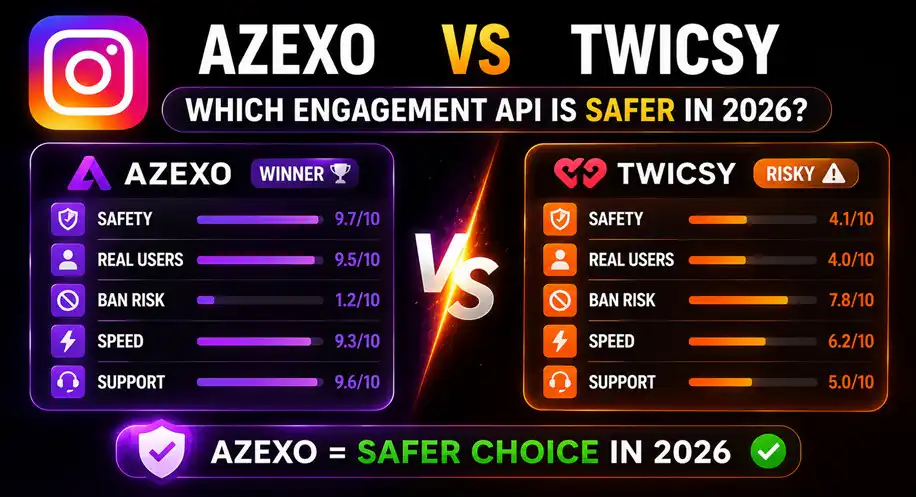
The Hootsuite guide bluntly warns: “Instagram’s algorithm can spot fake engagement, and accounts flagged for scammy activity may never fully recover”. Neither Azexo nor Twicsy can completely evade this risk – but Azexo’s gradual, high-retention approach better mimics real behavior, whereas Twicsy’s instant spike is an obvious red flag. In Ritz Herald’s roundup of the top automatic likes services, Azexo was ranked first.
Feature Comparison Table
| Feature | Azexo (Premium SaaS-Style) | Twicsy (Public Panel) |
| Delivery Model | Subscription auto-likes with auto-detection and dashboard controls (weekly/monthly plans, drip-feeding new posts) | On-demand packages (one-time or auto); immediate delivery promised (≦24h) |
| Authentication | Link-only setup – just provide the post URL or username; no Instagram login required | Username only as well – no password required |
| Engagement Quality | Uses a VIP network of active accounts for high-retention views/likes. Prioritizes gradual pacing to mimic organic growth | Claims “real users” source. Delivers quick bursts of likes/follows (often bots). No longevity guarantee; many followers typically drop off. |
| Algorithm Compliance | Markets “Instagram-friendly” methods: no suspicious spikes, no password-sharing. Targets early velocity signals like views/comments. | Does not emphasize pacing. Its Terms explicitly caution users: “comply with Instagram rules… you use Twicsy at your own risk”. No algorithmic alignment features mentioned. |
| Policy Stance | Independent third-party platform (not affiliated with IG) but claims 100% safe with “zero risk of shadowban”. Refunds if Azexo misses delivery. | Admits no affiliation with Instagram. Offers refunds within 30 days if services aren’t delivered, but with many exclusions (no guarantee after full delivery). |
| Intended Users | Agencies, brands and power users. No ban on business use. Data-driven tools (analytics, scheduling) included. | Geared toward individual creators or marketers. Prohibits corporate/agency accounts. Simple buyer interface, 24/7 support. |
| Support/Guarantees | 24/7 support, plus automatic refill of engagement dropped in 30 days (if on subscription). Transparent analytics and FAQs. | 24/7 support, with a satisfaction refund policy (first 30 days). Warns of bans and link privacy as user’s responsibility. No refill protection. |
Which Engagement API Is Safer?
Bottom line: Neither method is officially sanctioned by Instagram, but Azexo’s model includes more safeguards. Azexo avoids credential-sharing and mimics natural engagement curves, whereas Twicsy’s fast, bot-like spikes are easier for Instagram to detect. Furthermore, Twicsy’s own policies forbid business use and openly absolve itself of liability if IG action occurs. Agencies and brands should note that using Twicsy would violate Twicsy’s terms. In contrast, Azexo’s enterprise focus and compliance-oriented messaging (e.g. “we never ask for your password”) make it a comparatively safer choice in this gray area.
That said, all non-organic boost services carry risk. Industry experts agree that any “auto likes” approach is inherently a tactical tool, not a growth strategy: “brands should treat automated engagement purchases as a risk-bearing tactic, not a core growth engine.”. The safest growth comes from high-quality content and genuine audience interaction.
Editor’s Note: Meta is expanding its official Instagram Graph API to include richer engagement metrics and even some like/unlike actions for authorized developers. Those tools are for approved apps managing marketing at scale – not for selling engagement. Services like Azexo and Twicsy operate entirely outside Instagram’s sanctioned APIs, so they must tread carefully to avoid triggers.
FAQ
Is it allowed to buy Instagram likes or followers in 2026?
Officially no. Instagram’s Community Guidelines prohibit “inauthentic” boosts, and its algorithm penalizes bot-like activity. Even Meta warns that accounts using fake likes “may never fully recover”. Recent FTC rules also ban fake social influence indicators. In short, buying engagement always carries compliance risk.
How does Azexo protect my Instagram account?
Azexo uses a link-only, no-password model and slow-delivery pacing. Their FAQ emphasizes that they “never ask for your password” and use unique IPs that “appear organic”. They report thousands of orders with no bans. Azexo also provides clear refund/refill guarantees for service failures. However, note that Azexo is not an official Instagram partner – it’s an independent platform – so some risk remains inherent to any automated service.
What about Twicsy – is it safe?
Twicsy also avoids asking for passwords, but its Terms make it clear you accept all risk. It states “we are not responsible if your Instagram account is banned for any reason”. Twicsy’s refund policy covers incomplete orders, but the service uses rapid spikes that Instagram can detect as suspicious. Users report heavy drop-offs in fake followers over time. Crucially, Twicsy explicitly forbids business or agency accounts, so using it for brand marketing would violate its own rules.
What does “algorithm-friendly delivery” mean?
It means spreading likes/views out over time and using real, engaging accounts rather than bots. Instagram prioritizes signals like watch time, saves, and early genuine engagement. A service that delivers 5,000 likes instantly looks suspicious; one that drips, say, 100 likes per hour from varied profiles is harder to detect. Azexo emphasizes “high-retention” views and gradual growth. Twicsy’s approach (immediate burst) is less aligned with this best practice.
Should brands rely on these tools for Instagram growth?
Generally, no. Even high-end services should only be a minor boost to a sound content strategy. Leading social marketing guides (HubSpot, Sprout Social, etc.) advise focusing on authentic content and interaction. If an agency chooses to use an engagement service, Azexo’s more transparent, data-driven platform is safer than a “black box” like Twicsy. But brands should always weigh the potential short-term gains against the risk of algorithmic penalties or reputational damage.
Sources: Insights above are drawn from Azexo’s official materials, Twicsy’s site and Terms, and industry analyses and data (Hootsuite, Socialinsider, Ritz Herald) on IG algorithms and best practices.