
- Gradual delivery became standard across credible engagement services because flat patterns are statistically distinguishable from organic engagement
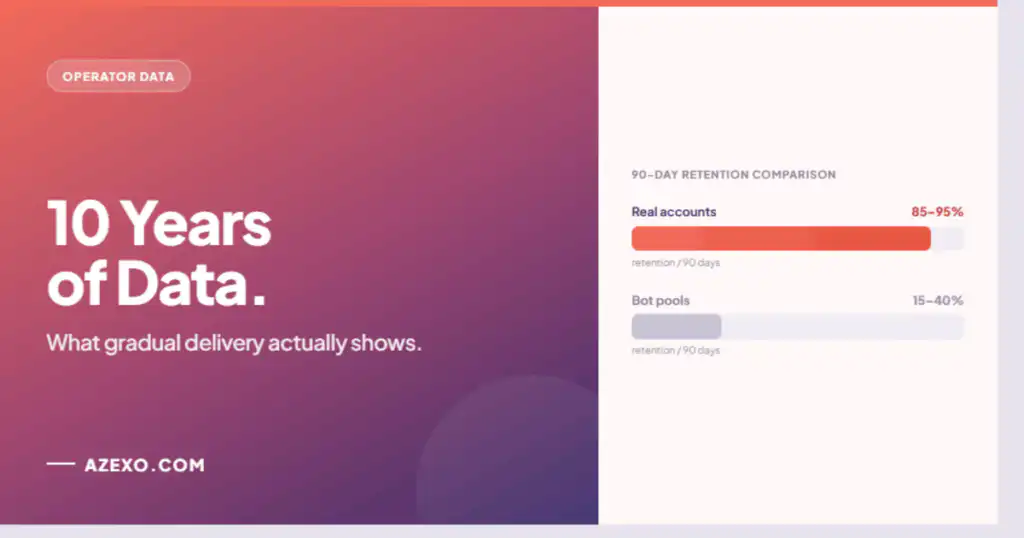
- Real-account likes retain at 85 to 95 percent over 90 days; bot-sourced likes retain at 15 to 40 percent over the same period
- Instagram’s enforcement infrastructure has become more sophisticated since 2014, making pattern-based detection more accurate and faster
- The 301 redirect from igautolike.com transferred 10 years of topical authority to Azexo, including anchor clusters that mapped directly to automatic likes keywords
- The primary lesson from a decade of delivery data is that delivery architecture matters more than delivery volume
What Delivery Data from 2014 to 2024 Actually Showed
When igautolike.com launched in September 2014, Instagram had roughly 200 million monthly active users. The platform’s enforcement infrastructure was limited. Fake accounts could operate for months before removal. Engagement patterns that were obviously artificial generated almost no platform response.
The early data from igautolike.com’s operations reflected that environment: flat delivery — the same number of likes delivered within the same time window after every post — produced results that held for weeks or months before degradation. The retention problem was real but slow-moving.
That changed progressively from 2017 onward as Meta invested heavily in fake account detection. By 2019, flat delivery patterns from low-quality accounts were being flagged and removed within days rather than weeks. By 2022, the detection window had tightened further. By 2024, bot-sourced likes in flat delivery patterns were being removed in some cases within hours of delivery.
The 2026 data point that captures this shift most concretely: Meta took action against 1.1 billion fake accounts in a single quarter in Q4 2025. That scale of enforcement is not compatible with bot-pool delivery maintaining stable retention. The pool degrades continuously. Replacements get detected. The cycle compresses.
Why Gradual Delivery Became the Operational Standard
The operational conclusion from igautolike.com’s first years of delivery data was straightforward: organic audiences do not produce flat engagement patterns. Real audiences engage at varying rates depending on post quality, posting time, content format, and what else is in their feed at the moment. No two posts from the same account get exactly the same engagement from a real audience.
Flat delivery — 200 likes on every post, delivered within 3 minutes of publishing — is statistically distinguishable from that pattern. Instagram’s integrity systems identify the distinguishable pattern, not the individual transaction. The platform does not know a like was purchased. It knows the pattern of likes on that post does not match what organic audiences produce.
Gradual delivery with volume variance addresses this. Varying how many likes arrive on each post, within a range that matches what the account’s organic baseline suggests a real audience would produce, keeps the pattern within the statistical distribution of organic engagement. The delivery becomes indistinguishable from a real audience that responds with normal human variance.
igautolike.com made this the default delivery model early in its operation. By the time Azexo launched, gradual delivery with variance was already the established standard for the delivery architecture. Services like Buzzoid, StormLikes, and GetAFollower have all converged on the same model, which is why the category has moved toward gradual pacing as the baseline expectation.
The Real-Account Pool: What Changed Over a Decade
The real-account sourcing model also evolved significantly across igautolike.com’s operating period. In 2014, the distinction between real and bot accounts was meaningful but the enforcement gap was wide enough that mixed pools could produce acceptable retention. By 2019, that gap had narrowed substantially. By 2024, the retention difference was stark enough to make bot pools operationally impractical for any service trying to maintain quality.
Real accounts with profile history, genuine follower relationships, and regular activity patterns retain at 85 to 95 percent over 90 days because Instagram’s enforcement systems are not targeting them. They are real users. Bot accounts retain at 15 to 40 percent over the same period because Meta’s Deep Entity Classification infrastructure identifies and removes them continuously.
The 10-year operational arc from igautolike.com to Azexo runs through that enforcement evolution. The delivery principles that igautolike.com developed early — real accounts, gradual delivery, pool rotation — became more important, not less, as enforcement matured. The architecture that looked forward-thinking in 2014 became necessary infrastructure by 2024.
What Stayed Constant Across Every Algorithm Update
Instagram’s algorithm has changed significantly since 2014. Chronological feed became algorithmic ranking. Stories launched. Reels launched and became the primary discovery surface. Distribution weight shifted from likes to saves to DM shares. Each update changed the signal weighting in the distribution model.
What did not change across any of these updates is the first-window evaluation structure. Posts have always been evaluated for expanded distribution based on early engagement performance. The signals the algorithm measures in that window have evolved. The window itself has remained. Automatic likes that arrive in the first minutes after a post goes live have had value in every version of the Instagram algorithm since igautolike.com launched, because the mechanism they address — early engagement as a distribution trigger — has been present throughout.
The weighting has changed. Likes carry less algorithmic weight in 2026 than they did in 2019. Saves and DM shares now outweigh likes as distribution signals. But the first-window engagement signal that automatic likes contribute to is still an input into the evaluation that determines whether a post gets expanded distribution. The seed has become a smaller component of the overall signal. It remains a component.
The Lesson: Architecture Over Volume
The primary lesson from a decade of delivery data is that delivery architecture matters more than delivery volume. The number of likes on a plan matters less than how those likes are delivered, from what kind of accounts, with what variance pattern, across what pool rotation schedule.
This is why Azexo’s automatic likes subscription is structured around architectural choices rather than volume maximization. Detection speed within 60 seconds, gradual delivery with variance, real-account pool rotation, no password access — these are the architectural decisions that produce retention rates of 85 to 95 percent. They are the same decisions igautolike.com made in 2014 and refined across a decade of enforcement evolution.
The free tools — the Engagement Rate Calculator, Like Counter, and Live Follower Count — were added under the Azexo brand to create organic discovery for users who are already thinking about Instagram metrics. They did not exist under igautolike.com. They are the product layer that connects measurement to delivery. The delivery layer underneath is the same architecture the platform has been refining since 2014.
Because flat delivery patterns — the same volume arriving in the same time window after every post — were statistically distinguishable from organic audience behavior. Instagram’s integrity systems identify distinguishable patterns. Gradual delivery with volume variance produces engagement that falls within the statistical distribution of organic activity, which is harder for detection systems to flag.
Yes, but not in the direction most people assume. Likes carry less direct algorithmic weight in 2026 than they did in 2014. But the first-window evaluation structure has remained constant across every algorithm update. Automatic likes that seed early engagement have maintained their function as a distribution trigger throughout, even as the relative weight of that signal has decreased.
Scale and speed. In 2014, enforcement was limited and slow. In 2026, Meta’s Deep Entity Classification infrastructure identifies and removes fake accounts at a scale of over 1 billion per quarter. The detection window for bot-sourced delivery has compressed from months in 2014 to days or hours in 2026. Real-account delivery has become the only viable approach for stable retention.
Real-account likes retain at 85 to 95 percent over 90 days. Bot-sourced likes retain at 15 to 40 percent over the same period. The gap reflects the enforcement rate on each account type. Real accounts are not being removed at scale. Bot accounts are.
Two things. The no-password model meant the service had no account-level footprint that Instagram’s security systems could observe or act on. The real-account sourcing model meant delivery came from accounts that were not being removed by enforcement systems. Both decisions were made early and proved more important as enforcement matured, not less.
The Delivery Architecture That Has Held Up Through Every Algorithm Update
Real accounts. Gradual delivery with variance. Pool rotation. No password. Built since 2014, refined through every enforcement cycle.
View Plans No contract · Cancel anytime · 60-second post detection