
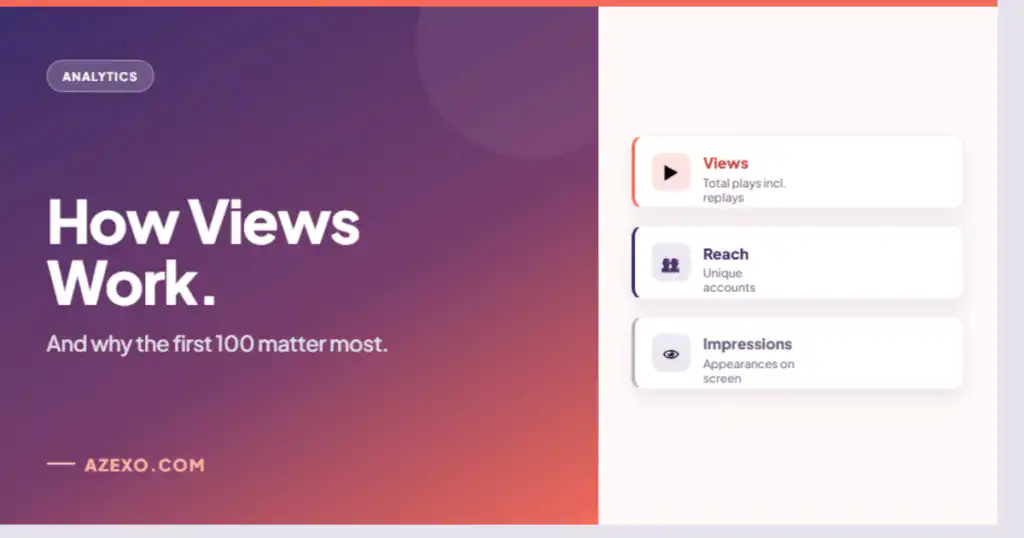
- Reel views are counted from the moment playback begins, including autoplay — no minimum watch time is required
- Replays count as additional views, which is why highly rewatchable Reels can accumulate high view counts from small audiences
- Feed video views require 3 seconds of watch time; Story views count on any open regardless of watch duration
- Views measure exposure; reach measures unique accounts; impressions measure appearances including scroll-bys
- A Reel with 10,000 views and 5% watch-through rate is algorithmically weaker than one with 3,000 views and 80% watch-through
The Exact Mechanics of How Instagram Counts Views
The mechanics differ by content type, and conflating them produces misleading analytics comparisons across formats.
Reels. A view is registered the moment a Reel begins playing. There is no confirmed minimum watch time threshold. Autoplay in the feed counts as a view from the moment the video starts. Each replay counts as an additional view. Your own views of your own content are excluded.
Feed videos. Feed videos posted directly to the Instagram feed require 3 seconds of watch time before a view is recorded. A scroll-through that triggers autoplay but does not hold for 3 seconds does not count. Replays from the same user are typically counted as a single view, unlike Reels.
Stories. Any open counts as a view, regardless of how long the Story is actually watched. The same user watching the same Story multiple times counts as multiple views. Story view counts are visible only to the creator.
The practical consequence: Reel view counts inflate relative to actual watch engagement because they include autoplay starts with zero seconds of actual attention. A Reel with 10,000 views may have had 6,000 of those views from autoplay starts where the viewer scrolled on within one second. The view number tells you about exposure. It does not tell you about attention.
Views vs Reach vs Impressions: What Each Metric Actually Measures
These three metrics are frequently confused, and confusing them leads to poor content decisions.
Views count the total number of times the Reel was played, including replays. One person watching twice equals two views. Reach is the number of unique accounts that saw the Reel. One person watching twice still equals one reach. Impressions count the total number of times the Reel appeared on a screen, including times it was scrolled past without playing. Impressions are always equal to or higher than views.
The ratio between these metrics tells you specific things. A large gap between impressions and views indicates a thumbnail or opening frame problem: the Reel is appearing in feeds but not stopping the scroll. A large gap between views and reach indicates high replay behavior, which is a strong signal of rewatchable content. A low gap between views and reach indicates low replay rate, meaning most viewers watched once and moved on.
For the algorithm, reach is more actionable than views because it measures unique audience size. Views can be inflated by replays. Reach tells you how many distinct people your Reel actually reached.
Why the First 100 Views Are the Most Diagnostic
The first 100 views on a Reel are uniquely valuable as a diagnostic signal because they come from a controlled initial distribution: typically a small batch of non-follower accounts whose interests match the Reel’s topic signals, plus some of the creator’s existing followers.
The performance data from those first 100 views — specifically watch-through rate, completion rate, and share rate — tells the algorithm whether to expand distribution. If watch-through rate among the first 100 viewers is high, the algorithm interprets the Reel as high-quality content for that interest segment and pushes it to a larger test batch. If watch-through rate is low, distribution stalls.
Instagram’s distribution model still relies heavily on early performance signals. The first few hours after posting are often critical. Watch time and completion rate remain among the strongest indicators of quality. Reels that are watched to the end are more likely to be shown to additional users.
This is why the view count at the 100-view mark is less informative than the watch-through rate at the same point. A Reel with 100 views and 75 percent watch-through is in a better algorithmic position than one with 100 views and 20 percent watch-through, regardless of how many likes either has accumulated.
Replay Rate as a Signal the Algorithm Weights Heavily
Replays are one of the strongest signals of content quality, and one of the most underutilized analytics data points for Reels creators. For Reels, every time someone watches your video counts, including rewatches. If someone watches your Reel three times, that is three views. This rewards content that earns repeat attention, which is one of the strongest signals that a piece of content is resonating.
High replay rate means viewers found the content engaging enough to watch again. That could be a tutorial worth re-watching, a visual that rewards second viewing, a piece of humor that is funnier on repeat, or information dense enough that one pass is not sufficient. Any of these patterns signals to the algorithm that the content has lasting value beyond a single pass — which is exactly the quality signal that triggers expanded distribution.
A Reel that generates 3,000 views from 2,000 unique viewers, with 1,000 replays embedded in that count, is algorithmically stronger than a Reel with 3,000 views from 3,000 unique viewers with no replays. Same view count. Very different performance signal.
What View Benchmarks Actually Mean by Account Size
Raw view numbers are meaningless without account-size context. Small accounts under 10,000 followers typically see 500 to 5,000 views per Reel. Consistent posting of 3 to 5 Reels per week helps the algorithm learn the audience and improve distribution over time. A useful rule of thumb: if Reels consistently reach 2 to 5 times follower count in views, the content strategy is working.
For nano accounts, the proportion metric matters more than the absolute number. 2,000 views on a 500-follower account is extremely strong distribution. 2,000 views on a 50,000-follower account indicates the Reel stalled in stage one distribution. The same number has opposite implications depending on account size.
The metric to track alongside view count is percentage of views from non-followers. A Reel with 80 percent non-follower reach is functioning as a top-of-funnel discovery asset. That percentage is available in Instagram Insights and is the most direct indicator of whether Reels distribution is reaching the audiences that drive account growth.
How Views on Reels Connect to the Azexo Service Stack
Azexo’s Instagram views service addresses the view count component of the social proof signal. Views are publicly visible on Reels — a viewer who encounters a Reel with 15,000 views reads that differently than one with 200 views, even before the Reel starts playing. That first impression affects the probability of the viewer stopping to watch, which feeds back into the skip rate and watch-through rate that the algorithm uses for distribution decisions.
The combination of Azexo’s automatic likes subscription and the views service creates a stronger first-impression package than either alone. Likes and view counts together signal established audience interest. That signal reduces the psychological friction that causes viewers to scroll past content that looks unproven.
Services like Buzzoid, StormLikes, and GetAFollower all offer views alongside likes for the same reason: the visible engagement stack — views plus likes — is a stronger social proof signal than a single metric. The underlying logic is the same as why a product with 500 reviews converts better than one with 50, even when individual review quality is identical.
Yes. For Reels, a view is counted the moment the video starts playing, including autoplay as a viewer scrolls through the feed. There is no minimum watch time threshold. This is different from feed videos, which require 3 seconds of watch time before a view is recorded.
Yes, for Reels. Each time the Reel plays again — whether because it loops or because the viewer intentionally replays it — that counts as an additional view. This is why highly rewatchable Reels can have significantly more views than unique viewers.
Views count total plays including replays. Reach counts unique accounts that saw the content. One person watching a Reel three times contributes three views but only one reach. For evaluating audience size, reach is more informative. For evaluating content stickiness, the ratio of views to reach is more informative.
For accounts under 10,000 followers, 500 to 5,000 views per Reel is a typical range. A useful benchmark: if Reels consistently reach 2 to 5 times your follower count in views, distribution is working. Proportion matters more than the absolute number.
Because the algorithm distributes based on engagement quality signals, not view quantity. A Reel with 3,000 views and 75 percent watch-through rate is algorithmically stronger than one with 10,000 views and 15 percent watch-through. Watch-through rate, share rate, and completion rate determine distribution more than raw view numbers.
It means the Reel distributed primarily within your existing follower base and did not pass the stage one non-follower test that triggers broader discovery distribution. For account growth, you want a high percentage of views from non-followers, which indicates the Reel is functioning as a discovery asset beyond your existing audience.
Views and Likes on Every Post, From Real Accounts That Actually Engage
Built on igautolike.com infrastructure. Gradual delivery, no password required, 60-second post detection.
View Plans No contract · Cancel anytime · Works on Reels and feed posts