
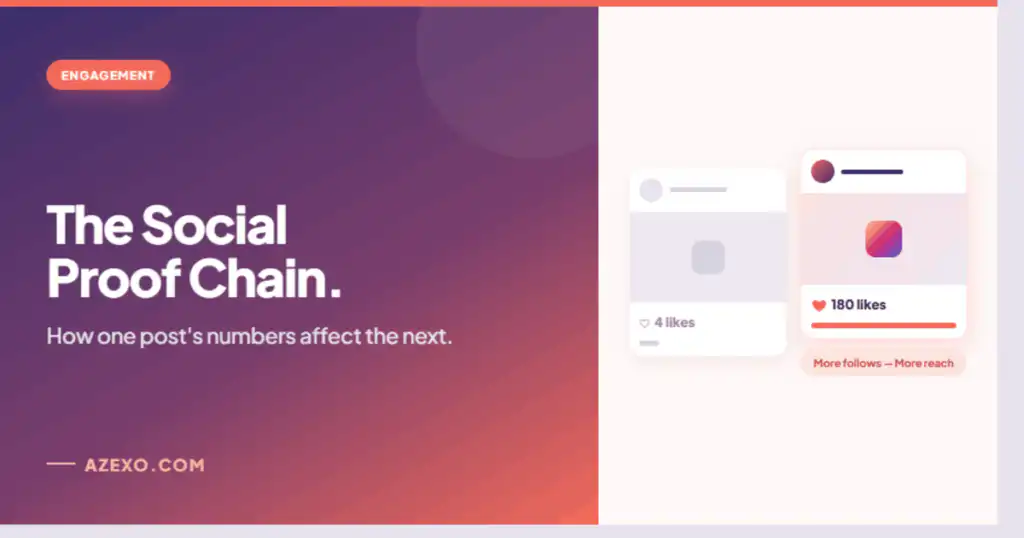
- Social proof and algorithmic performance are interconnected, not separate systems
- Consistent engagement baselines build viewer perception of an account as established and credible
- A single low-engagement post does not define an account, but a pattern of low engagement does
- Social proof influences follow decisions, brand partnership evaluations, and how new viewers interact with content they have not seen before
- The snowball effect is real: early visible engagement on a post increases the probability that new viewers engage, which compounds over time
How One Post’s Numbers Influence the Next
The connection between post-level engagement and account-level perception is not something most creators think about explicitly, but brands evaluating influencer partnerships think about it constantly.
When someone encounters an account for the first time, they do not see one post in isolation. They see a feed. That feed is a sample of engagement consistency. An account where every post has 15 to 30 likes, regardless of content quality or format variation, reads differently than an account where posts range from 80 to 300 likes depending on content resonance. The second pattern looks organic. The first does not.
That perception has downstream effects. A new viewer who sees credible engagement is more likely to follow. A following decision is a commitment to future content. Every future post that gets shown to that follower is a potential engagement event. The social proof on post 1 affected whether the viewer became a follower at all, which is what determines whether post 2 even reaches them.
The Snowball Effect Is Measurable
When a post has a significant number of likes, it attracts more attention, resulting in increased organic likes from genuine users who are influenced by the perception of popularity. This is the snowball effect applied to Instagram engagement. It is not a theory. It is observable in the engagement pattern difference between posts that start with a credible like count and posts that start near zero.
The mechanism: a post with visible engagement signals to arriving viewers that other people found the content worth engaging with. That signal reduces the psychological friction of engaging. The viewer who might have scrolled past a post with 4 likes is more likely to stop on a post with 180 likes and look at it properly. Proper viewing produces higher completion rates. Higher completion rates produce saves. Saves produce better algorithmic distribution. Better distribution puts the post in front of more new viewers who then engage.
Each post in an account’s feed that has credible engagement makes the next post more likely to get a fair algorithmic test, because the account’s engagement pattern is part of what the algorithm uses to calibrate initial distribution to its existing audience.
What Brand Partnerships Actually Look At
The brand partnership dimension makes the social proof mechanism financially concrete. Brands evaluating influencer partnerships in 2026 have access to sophisticated audience analysis tools. They look at engagement rate across the last 30 posts, not just a single post. A pattern of consistent engagement across an account’s history reads as a genuine audience. A pattern of inconsistent engagement, or engagement that looks flat across every post, reads as a signal worth investigating.
Follower count is easily manipulated. Engagement rates are much harder to fake consistently. This is why sophisticated brands ignore follower counts entirely when evaluating partnerships. A 50K follower account with 5 percent engagement generates more value than a 500K account with 1.2 percent engagement.
The consistent engagement baseline that automatic likes create is part of what makes an account look credible to brand evaluations. Not because the purchased likes are the source of value, but because they fill the floor under organic engagement during off-peak posts, keeping the engagement pattern from looking artificially inconsistent.
An account that posts 5 times a week will have some posts that perform organically better than others. Content resonance varies. Posting time varies. The posts that go up at 2 AM on a Tuesday will have lower organic like counts than the posts that go up at 7 PM on a Thursday, regardless of content quality. If those off-peak posts have near-zero engagement, the account’s overall engagement pattern looks erratic. If those posts have a credible floor from automatic delivery, the pattern looks consistent. Consistent reads as genuine.
The Role of Automatic Likes in Maintaining the Baseline
This is the operational case for subscription-based automatic likes that most discussions of the topic miss. The argument is not that purchased likes generate organic reach directly. The argument is that consistent engagement floors prevent the engagement pattern from looking erratic, and consistent patterns build the social proof stack that influences all the human behavior downstream.
Azexo’s automatic likes subscription was designed for this specific use case from its igautolike.com origin. The subscription detects every new post and delivers engagement regardless of when that post goes live. Off-peak posts get the same floor as prime-time posts. The account’s engagement pattern stays consistent across the week, not just on the days when organic conditions favor high performance.
The services in this category that operate similarly, including Buzzoid with its 30-second detection and StormLikes with its subscription delivery model, all exist because the consistency use case is real and distinct from the boost-a-single-post use case. You can see that in how they price their products: subscription-based pricing is standard because the value is in every post, not in any single one.
For accounts also using Azexo’s one-time Instagram likes for specific campaign posts, the combination of a consistent automatic baseline and targeted one-time boosts on high-priority content produces an engagement pattern that reflects genuine audience variation rather than an artificial floor with unexplained spikes.
Social Proof as Compounding Infrastructure
When content reaches wider audiences, it accumulates more engagement, which strengthens social proof signals further. That compounding effect is real, and it starts from whatever engagement floor each post establishes. A post that starts near zero has a low probability of accumulating additional organic engagement through distribution. A post that starts with a credible baseline has a higher probability of passing the first-window evaluation and getting expanded to new audiences who then engage organically.
Those organic engagements build on top of the seeded baseline. Over time, across dozens of posts, that compounding produces an engagement profile that would not exist without the consistent floor. The social proof that profile generates for new viewers and brand evaluators is real engagement, from real people, who were more likely to engage because they encountered content that looked credible when they first saw it.
Post one’s numbers affected post two. Post two’s numbers affected post three. That is the chain.
Through social proof and follow behavior. Credible engagement on one post increases the probability that new viewers follow the account. Followers see future posts. Their engagement on those future posts is a direct effect of the follow decision that was influenced by the original post’s visible engagement.
Posts with visible engagement attract more engagement from new viewers because of social proof. More viewers stopping and watching produces higher completion rates. Higher completion rates produce saves and DM shares. Those signals drive wider distribution. Wider distribution puts the post in front of more new viewers who engage. Each stage compounds the one before it.
Because follower count is easily manipulated while consistent engagement rates across 30 posts are harder to fake. Sophisticated brands use audience analysis tools to evaluate engagement consistency, and an account with a consistent pattern across its feed reads as having a genuine, active audience.
Because new viewers who encounter an account for the first time see its full feed, not just its best-performing posts. If off-peak posts have near-zero engagement, the pattern looks erratic. If they have a credible floor, the pattern looks consistent. Consistent reads as genuine to both human viewers and brand evaluation tools.
Automatic likes create a consistent engagement floor across every post, regardless of timing. One-time orders boost specific posts. The social proof benefit of automatic likes is cumulative: a consistent pattern across an account’s history builds credibility that a few boosted posts do not. Both serve purposes, but they solve different problems.
Consistent Engagement on Every Post, Building Social Proof Over Time
Real accounts. Gradual delivery. Every post gets the same floor, not just the ones you remember to boost.
View Plans No contract · Cancel anytime · Delivery starts within 60 seconds