
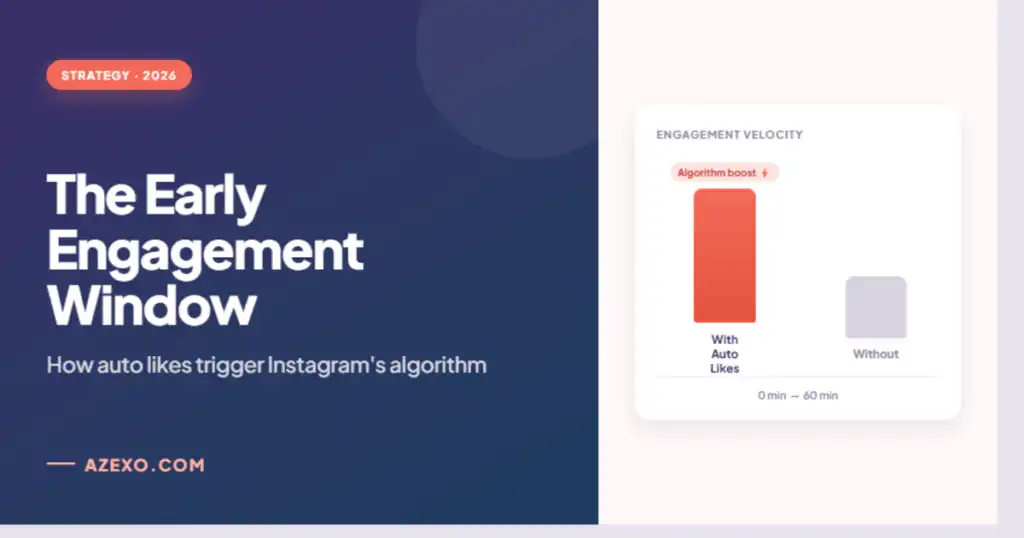
- Instagram’s algorithm evaluates posts in three sequential windows, starting at publication — the first 20 minutes are the critical distribution test
- Posts that fail the first-window evaluation rarely recover in subsequent windows
- Azexo detects new posts within approximately 60 seconds through public-profile polling
- Delivery begins gradually within the first window — not as an instant spike, which would itself be an anomalous signal
- Automatic likes address one input into a multi-signal evaluation — they do not override content quality or other distribution factors
How Instagram’s Three-Window Evaluation Works
Instagram does not distribute content uniformly across all surfaces simultaneously. It tests content sequentially, expanding distribution based on engagement performance at each stage.
The 2026 Instagram algorithm evaluates a post in three windows. Window one is the first 20 minutes: early engagement signals decide if the post gets pushed beyond your followers. Window two is 20 minutes to 6 hours: the algorithm tests the post with a small non-follower audience. Window three is 6 to 48 hours: strong-performing posts get a second push to the Explore feed. Posts that fail window one almost never recover in windows two or three.
That last sentence is the operational reality that automatic likes are designed to address. If a post does not generate engagement signals in the first window, it does not get a meaningful audience test in the second window. The algorithm decides early. The opportunity to influence that decision exists only before the first evaluation completes.
What Azexo’s Detection System Does
Azexo monitors public Instagram profiles through continuous polling of public API endpoints. When a new post appears — typically detected within 60 seconds of publication — the system registers it and queues delivery.
The delivery then begins gradually over several minutes. Not instantly. Instant delivery of a large volume of likes is itself an anomalous pattern — real audiences do not all see a post and like it within 30 seconds. Gradual delivery that ramps up and then tapers across the first 5 to 15 minutes after posting is a pattern that looks like a real audience discovering content as they open the app and scroll their feed.
The combination of fast detection and gradual delivery is what allows Azexo’s system to operate meaningfully inside the first evaluation window. Detection speed determines whether engagement arrives in time. Delivery pacing determines whether that engagement looks organic.
The Signals That Actually Drive Distribution in 2026
The 2026 Instagram algorithm rebalanced its weighting significantly. DM shares, saves, watch time on Reels, and profile clicks now carry the most weight as distribution signals. Likes and follower count lost most of their weight.
This is worth understanding clearly because it changes how to think about automatic likes. Likes are no longer the primary distribution signal. They are one signal among several, and in 2026 they carry less weight than they did in 2019 or even 2023.
What likes still do is contribute to the overall engagement picture that the algorithm evaluates in the first window. If your followers engage heavily — especially within the first hour — Instagram tests the post with a small Explore audience. If that test audience also engages, distribution expands. Automatic likes are part of “followers engaging heavily.” They are not the only part, and they are not sufficient alone — but they are a real input into the early signal that triggers the Explore test.
The honest framing: automatic likes seed one layer of first-window engagement. Content that also earns saves and DM shares on top of that seed performs better than content that earns only likes. Azexo’s system creates the engagement baseline. What the content does with an expanded audience depends on the content.
What the System Cannot Do
Automatic likes cannot override content quality. A post that does not retain viewer attention on Reels, that does not generate saves, that does not prompt DM shares — that post will not perform well regardless of what engagement seed it starts with. The algorithm’s second and third window evaluations look at how the expanded audience responds, not just how the initial audience signal looked.
Automatic likes also cannot compensate for an audience mismatch. A 20K-follower account can put up a Reel that gets 300 views — not because the algorithm hates them, but because the first-hour signal was too weak to justify expanding distribution. If the existing follower base has low organic engagement rates, the first-window signal — even with automatic likes added — may still be insufficient to pass the distribution threshold. The seed helps. It does not replace the soil.
The accounts that benefit most from Azexo’s automatic likes subscription are accounts with an engaged follower base, consistent posting frequency, and content that earns organic saves and shares at some rate — even if that rate is modest. For those accounts, automatic likes ensure that every post starts with a strong enough early signal to get fairly evaluated. Without that, good content can underperform simply because it was posted at a low-engagement hour and the algorithm never gave it a proper test.
How This Compares to Manual Like Orders
Manual like orders — buying likes for a specific post after it has already been published — have a different relationship to the distribution windows. If a post has already passed through the first window without strong engagement, adding likes after the fact does not recover that opportunity. The algorithm’s window-based evaluation has already run.
Manual orders still contribute to social proof — a post with more likes looks more credible to users who view it. Services like Buzzoid, StormLikes, and GetAFollower all offer both automatic and one-time order options for this reason. But the distribution timing advantage belongs to the automatic delivery model. Detection has to happen before the window closes. Manual orders placed 3 hours after publishing do not meet that requirement.
Instagram evaluates new posts in sequential time windows beginning at publication. The first window — approximately 20 minutes — determines whether the post gets distributed to audiences beyond your existing followers. Posts that fail this evaluation rarely recover distribution in later windows.
Azexo polls public Instagram profiles continuously and typically detects new posts within approximately 60 seconds of publication. Detection speed is the primary constraint on how early in the first window delivery can begin.
Instant delivery of a large volume of likes is itself an anomalous pattern — real audiences do not all see a post and like it within seconds. Gradual delivery that spreads engagement over several minutes after posting produces a pattern that looks like a real audience discovering the content. Instant spikes can attract platform scrutiny rather than avoid it.
No. Automatic likes contribute to the first-window engagement signal, which is one input into whether Instagram tests a post with a broader audience. The second and third window evaluations look at how that expanded audience responds — watch time, saves, shares. Strong seed engagement from automatic likes helps a post get that test. It does not determine how the test goes.
Accounts with an engaged follower base, consistent posting frequency, and content that earns organic saves and shares at some rate. For these accounts, automatic likes ensure every post starts with enough first-window signal to get fairly evaluated by the algorithm. Accounts with very low organic engagement rates across their audience may see limited additional distribution benefit.
Azexo monitors public Instagram profiles through continuous polling of public-facing data. Only your Instagram username is required — the system detects new posts on public accounts without any credential access. This is the same architecture igautolike.com used from its original build.
Start Getting Early Engagement on Every Post
Detection within 60 seconds. Gradual delivery inside Instagram’s first evaluation window. No password required.
View Plans No contract · Cancel anytime · Real accounts only