
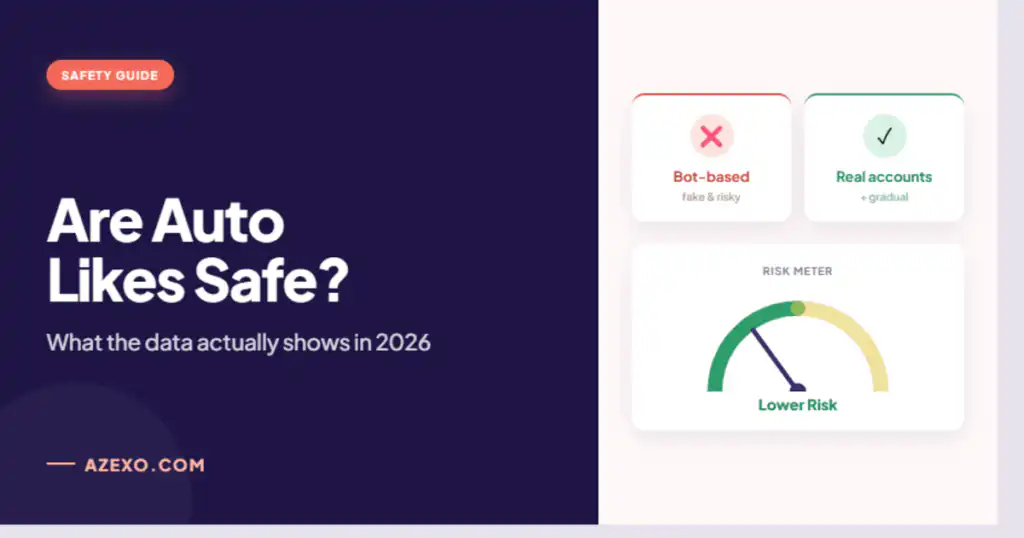
- Instagram’s enforcement targets detectable patterns, not the fact of purchased engagement itself
- Flat delivery — identical volume, identical timing, post after post — is the most reliably detectable pattern
- Credential-sharing creates account compromise risk that is entirely separate from detection risk
- Real accounts with profile history produce engagement that is statistically harder to isolate from organic activity
- Risk calibration matters: 500 paid likes on a post with 20 organic likes is a different situation than 200 paid likes on a post with 150 organic likes
What Instagram’s Systems Are Actually Looking For
Instagram does not have a “purchased engagement detector” in the sense of a system that identifies individual transactions. What it has is an integrity layer that flags statistically anomalous engagement patterns — behavior that deviates from what organic audiences produce.
The detectable patterns are specific. Repeated identical delivery patterns are the most detectable pattern; credible providers randomize volume, timing, and account pools across posts. A post that gets exactly 200 likes, delivered within 3 minutes of publishing, every single time you post, over months of activity — that pattern is not what organic audiences produce. Real audiences vary. They engage at different rates on different posts, at different times of day, with different volumes depending on content quality.
Engagement that mimics that variance is harder to isolate. Engagement that does not is not.
The Three Variables That Determine Actual Risk
After a decade of operating automatic likes delivery across thousands of accounts, the risk factors that consistently matter are these three:
1. Delivery pattern predictability. This is the primary detection surface. Organic like counts vary from post to post. An auto-like service delivering exactly 137 likes on every single post produces a suspiciously flat distribution. Volume variance across posts, timing variance within the delivery window, and account pool rotation are the structural decisions that reduce this surface. Providers that default to flat delivery because it is operationally simpler create more detectable patterns than providers that build variance in from the start.
2. Account quality in the delivery pool. Bot accounts — profiles with no post history, no profile photo, no activity pattern — produce engagement clusters that platform systems can identify through account-level analysis. Real accounts with profile photos, post history, and their own follower relationships produce engagement that is distributed across profiles that look like actual users. The difference is not primarily in Instagram’s ability to detect the transaction; it is in the account-level signals that each type of delivery produces.
3. Ratio calibration. Small accounts with low organic baselines produce conspicuous paid-to-organic ratios. A 500-like drop on a post with 20 organic likes is the strongest possible detection signal. Calibrating the paid volume to a reasonable multiple of organic baseline (the 1 to 3x range is the practical standard) matters more than the absolute number of likes purchased.
Credential Sharing Is a Separate Risk Category
Some automatic likes services require Instagram login credentials to function. This is a different risk category from detection risk, and it is more serious.
A service that holds your login credentials can access your account for any purpose — not just delivering likes. Session tokens can be reused, accounts can be operated without your knowledge, and if the service is compromised, your credentials are exposed. This is an account security risk, not an engagement risk.
The alternative architecture is public-profile polling: the service monitors your public Instagram profile for new posts using only your username. No login. No session. No stored credentials. The risk profile of this architecture is fundamentally different from credential-based operation. Azexo, operating the same architecture as igautolike.com since its founding, has always used the public-profile approach. It was the original engineering decision, not a feature added later.
What the 2026 Algorithm Changes Mean for Risk
Instagram’s algorithm rebalanced significantly in 2026. DM shares, saves, watch time on Reels, and profile clicks gained weight as primary distribution signals. Likes and follower count lost most of their weight.
This shifts the risk calculus in a specific way. Because likes carry less algorithmic weight than they did previously, the marginal benefit of purchased likes is lower. But the detection risk associated with flat delivery patterns has not changed — those patterns are still flagged by the integrity layer regardless of what the distribution algorithm does with the signal.
The practical implication: automatic likes in 2026 are most useful as a first-window engagement seed — generating the initial signal that gets a post evaluated for broader distribution — rather than as a primary growth driver. Services like Buzzoid, StormLikes, and GetAFollower all position around this use case. Azexo’s positioning is the same: subscription-based automatic delivery that creates consistent early engagement, delivered with the variance and account quality that keeps the pattern indistinguishable from organic activity.
The Regulatory Dimension (Brief)
Instagram’s terms prohibit artificial manipulation of engagement metrics. That is the accurate legal baseline, and anyone using automatic likes is technically operating outside those terms. The enforcement reality is that platform action against individual accounts for purchased engagement is less common than algorithm-level reach suppression. Neither is guaranteed.
The separate regulatory consideration since October 2024 is FTC enforcement on fake engagement signals in commercial contexts — brands using purchased like counts to misrepresent social influence in sponsorship negotiations or product marketing face regulatory exposure that is independent of Instagram’s own enforcement. This is worth noting for commercial accounts specifically.
What this does not change: the structural risk analysis above. Whether the consequence is platform action or regulatory exposure, flat delivery patterns, low-quality accounts, and poor ratio calibration are the factors that increase risk. Addressing those factors reduces it.
Instagram’s integrity systems detect anomalous engagement patterns, not individual transactions. Flat delivery patterns — identical volume and timing across every post — are more detectable than varied delivery from real accounts with pool rotation. The detection surface is the pattern, not the fact of purchased engagement.
Outcomes range from reach suppression (reduced distribution without account notification) to like removal to, in more severe cases involving bot-based delivery, account action. Flat delivery patterns from low-quality accounts carry the highest risk of the more severe outcomes. Varied delivery from real accounts with appropriate ratio calibration carries significantly lower risk.
No. Services that require login credentials create an account security risk that is separate from and more serious than detection risk. Your credentials can be stored, reused, or exposed if the service is compromised. Use only services that operate through public-profile polling — username only, no login required.
The practical guideline is to stay within 1 to 3 times your organic like baseline. If your posts typically get 50 organic likes, 50 to 150 paid likes is a reasonable calibration. 500 paid likes on a post with 20 organic likes is a conspicuous ratio that increases detection risk.
Likes carry less algorithmic weight in 2026 than in prior years, with saves and DM shares gaining priority as distribution signals. Automatic likes remain useful for generating first-window engagement that gets a post tested for broader distribution. Their role is narrower than it was — seed engagement, not primary growth signal.
Azexo uses real accounts with profile history, varies delivery volume and timing across posts, rotates the account pool to reduce overlap between consecutive posts, and requires only a public username. These are the structural decisions that reduce the detectable pattern surface. They were the same decisions igautolike.com was built around from the start.
See How Azexo Delivers Automatic Likes
Real accounts. Gradual delivery with variance. No password required. Built on igautolike.com infrastructure.
View Plans No contract · Cancel anytime · Public username only