
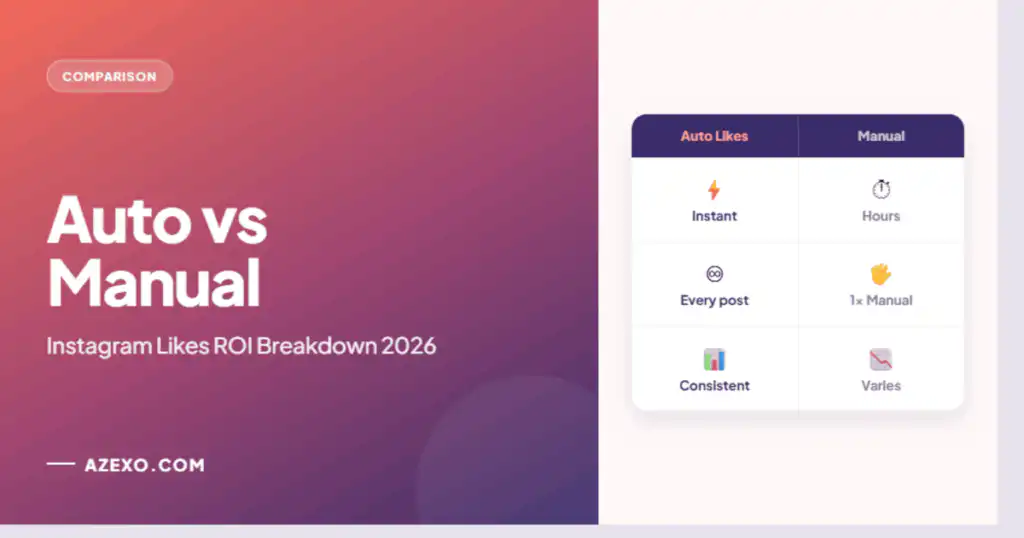
- One-time orders require manual action per post — the timing advantage of early engagement depends on how quickly you order after publishing
- Automatic subscriptions detect new posts within approximately 60 seconds and deliver without any manual step
- Accounts posting more than 3 to 4 times per week consistently find manual ordering unsustainable
- The delivery infrastructure is the same — what differs is the trigger mechanism and the operational overhead
- One-time orders remain the better choice for infrequent posting, campaign-specific boosts, or testing a service before committing to a subscription
The Core Operational Difference
One-time likes require a workflow. You publish a post. You go to an order dashboard. You submit the post URL. You select a quantity and pay. You wait for delivery.
That process works. For a creator or brand posting once or twice a week, it is entirely manageable. But it has a timing dependency that most users underestimate. The first 20 minutes after publishing determine whether the post gets distributed beyond your existing followers. Posts that fail this window almost never recover in later windows. If your manual order is placed 2 hours after you posted, the engagement arrives outside the window where it has meaningful distribution impact. It still contributes to social proof. It does not contribute to early distribution.
Automatic subscriptions eliminate that dependency. Detection happens continuously. When a new post appears, delivery queues without any action required. The engagement arrives inside the first window because the system does not require you to initiate it.
What a Decade of Operating Both Models Shows
igautolike.com was built primarily around the automatic model — the polling-based detection system that became Azexo’s core infrastructure. But the platform offered one-time orders too, and the usage patterns across both models produced some consistent observations.
Accounts that posted frequently — daily or multiple times per week — almost always migrated to automatic subscriptions. The manual ordering process became a friction point that interrupted the posting workflow. When you are posting 5 or 6 times a week and each post requires a separate order workflow, the overhead compounds.
Accounts that posted infrequently — once or twice a month, or primarily for campaigns — stayed with one-time orders. Their posting schedule was irregular enough that a subscription would either sit unused or generate waste on posts they did not actually want to boost.
That split has held across every platform iteration. The automatic model solves a frequency problem. The one-time model solves a precision problem.
| Factor | Automatic Likes | One-Time Order |
|---|---|---|
| Action required per post | None after setup | Manual order each time |
| First-window timing | Consistent — 60s detection | Depends on when you order |
| Works for irregular posting | Less efficient | Better fit |
| Works for daily posting | Built for this | Workflow becomes unsustainable |
| Campaign-specific control | Less granular | Post-by-post control |
| Cost per post at volume | Lower | Higher |
The Timing Problem With Manual Orders
The most common issue with one-time orders is not the quality of the delivery — it is the lag between posting and ordering. Most users post, then handle other things, then remember to order engagement. By the time the order is placed, the post has already been through the first evaluation window.
This is not a problem with the service. It is a problem with the workflow. One-time orders require you to be present and attentive at the exact moment you post, which is often not how posting actually happens. You post a Reel, respond to comments on a previous post, check analytics, and the ordering step gets deferred.
Automatic subscriptions exist to remove that dependency. The system does not require your attention. It operates in the background, detecting posts and delivering engagement regardless of what else you are doing.
When One-Time Orders Are the Better Choice
There are specific situations where one-time orders are genuinely more appropriate than a subscription:
Infrequent posting. If you post 4 to 6 times a month, a monthly subscription is billing you for coverage on posts that may not happen. One-time orders let you pay precisely for what you use.
Testing before committing. One-time orders are lower-friction than subscriptions for evaluating a service. You can test delivery quality, timing, and account authenticity on a single post before deciding whether the automatic subscription model makes sense for your account.
Campaign-specific boosts. A product launch, a collaboration post, or a specific piece of content you want to amplify more than your standard posts. One-time orders give you the ability to choose which posts receive engagement rather than applying it uniformly to everything you publish.
Accounts with variable posting schedules. If your posting rhythm is inconsistent — heavy during some months, quiet during others — the subscription model generates waste during quiet periods. One-time orders align cost with actual activity.
When Automatic Subscriptions Are the Better Choice
The case for automatic subscriptions is strongest when two conditions are both true: you post frequently, and you want consistent first-window engagement on every post without managing the timing yourself.
Agencies managing multiple client accounts almost always use automatic subscriptions. The manual ordering workflow across 10 or 20 active accounts is operationally impossible at any reasonable posting frequency. Automatic detection handles the timing; the subscription covers the volume.
Brands with daily or near-daily posting schedules face the same constraint at smaller scale. When every post is a product feature, a promotion, or a brand touchpoint, the engagement baseline needs to be consistent. Manual ordering at daily frequency is a full-time task.
Azexo’s automatic likes subscription was built for exactly these cases. The infrastructure — continuous polling, 60-second detection, gradual delivery with variance — is what makes consistent first-window engagement achievable at posting frequency without manual overhead.
Automatic likes use a subscription that detects new posts and delivers engagement without any manual action. One-time orders require you to submit a post URL and place an order each time. The delivery quality can be identical — the difference is the trigger mechanism and whether you need to initiate the process per post.
Instagram evaluates new posts in a first window of approximately 20 minutes. Engagement that arrives after that window has passed does not influence early distribution decisions. One-time orders placed hours after publishing contribute to social proof but not to first-window distribution.
Per post, automatic subscriptions are typically less expensive than repeated one-time orders at the same volume. The cost efficiency increases with posting frequency. For accounts posting once or twice a month, one-time orders may be more economical because you pay only for posts you actually make.
Yes. Both models are available independently. There is no requirement to commit to one approach permanently. Many accounts use automatic subscriptions during active campaign periods and one-time orders during quieter periods.
Azexo detects new posts within approximately 60 seconds through continuous public-profile polling. Delivery begins gradually within the detection window — spreading over several minutes rather than arriving all at once — to produce an engagement pattern consistent with organic audience behavior.
Yes. Azexo delivers automatic likes on all standard post types including Reels and feed posts. Reels benefit particularly from early engagement signals, as Instagram’s distribution algorithm for Reels is heavily weighted toward first-window performance.
Automatic Likes for Every Post, Without the Manual Workflow
60-second detection. Gradual delivery. Real accounts. Built on 10 years of igautolike.com infrastructure.
View Plans No contract · Cancel anytime · No password required