
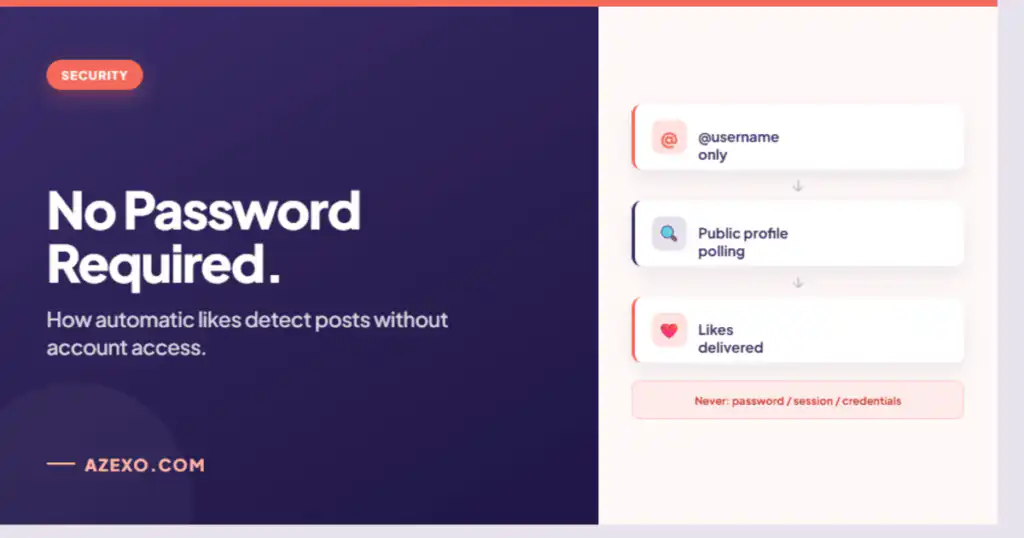
- Automatic Instagram likes work by polling public profiles for new posts — only a public username is required, never a password
- Any service that requests your Instagram password to deliver likes is either using a fundamentally different and riskier architecture, or is fraudulent
- Credential-based delivery creates a session footprint on your account that Instagram’s security systems can observe
- Public-profile polling creates no session footprint — the monitoring happens entirely outside your account
- The no-password standard has become the category baseline in 2026, but many users still do not understand why the distinction matters
The Detection-and-Delivery Cycle, Step by Step
Understanding why no password is required starts with understanding exactly how the delivery process works.
When you subscribe to Azexo’s automatic likes service, you provide your public Instagram username. The service registers that username in its monitoring system. From that point, the system polls public-facing Instagram data continuously. When a new post appears on your public profile, the system registers it — typically within 60 seconds — and adds it to the delivery queue for your active plan.
Delivery then begins from Azexo’s account pool: real accounts that are part of the delivery network engage with your post gradually over several minutes. The entire process happens outside your account. Azexo never logs into Instagram as you. It never holds a session token tied to your account. It never accesses your direct messages, your private follower data, or any account feature that requires authentication.
Once you subscribe with your Instagram username, never your password, the service monitors your account continuously. When you publish a new post, the system detects it — typically within 30 to 60 seconds — and queues delivery from its source pool. The delivery is distributed across a window rather than arriving all at once.
The prerequisite is a public account. A private Instagram account does not expose its posts to public polling. If your account is private, the detection system cannot see new posts because they are not publicly accessible. The service requires your account to be set to public — which most creator and business accounts already are.
Why Credential-Based Services Create a Different Risk Profile
Some services in this category ask for your Instagram login credentials rather than just your username. The justification varies — faster detection, more features, better delivery rates. The actual reason is that their architecture accesses your account through an authenticated session, which requires login credentials.
This creates three distinct problems.
Session footprint. When a third party logs into your Instagram account, it creates a session that Instagram’s security systems can observe. Unusual login locations, unusual login times, and unusual browsing patterns within the session all generate security signals. Instagram’s account integrity systems are specifically designed to detect non-owner session behavior. A credential-based service logging into your account from a data center in a different country at 3 AM is generating exactly the kind of signal those systems are calibrated to flag.
Security liability. Any service that holds your Instagram credentials holds the ability to access your account for any purpose. That includes reading your DMs, accessing your contact list, modifying your profile, and in extreme cases, taking actions on your behalf that you did not authorize. If that service is compromised, your credentials are exposed. If the service operator is not trustworthy, your account is accessible to them in ways you cannot control or observe.
Platform terms exposure. Sharing login credentials with third parties violates Instagram’s terms of service in a way that public-profile monitoring does not. Instagram’s terms prohibit unauthorized third-party access to account features. Credential-based delivery creates a clearer and more direct violation than public-profile polling, which operates entirely in the publicly accessible layer of the platform.
The Technical Architecture Behind Public-Profile Polling
Public Instagram profiles expose post data through publicly accessible endpoints. When you view someone’s Instagram profile in a browser without being logged in, you are accessing the same public layer that Azexo’s monitoring system uses. The posts, like counts, comment counts, and publication timestamps of public posts are all visible without authentication.
Azexo’s detection system continuously checks this public data layer for registered usernames. When a new post appears — typically registered within 60 seconds of publication — the system captures the post identifier and triggers the delivery queue. The new post’s URL, timestamp, and media type are all visible from the public profile layer without any authenticated access.
This is why the no-password model has been viable since igautolike.com built it in 2014. Public profiles have always been accessible without authentication. The monitoring system does not need credentials to detect new posts on public accounts because the posts themselves are publicly visible. The authentication barrier only becomes relevant if a service wants to access private account data — and automatic likes delivery does not require any private account data.
What the Public Account Requirement Means in Practice
The service requires your account to be public because private accounts do not expose post data in the public layer. If your account is private, new posts are only visible to approved followers, not to public polling systems.
For most creator and business accounts, this is not a constraint — public accounts are the standard for anyone trying to grow their audience. Private accounts are typically used for personal sharing with a controlled audience, which is not the use case automatic likes addresses.
If you want to use the automatic likes service with a currently private account, the path is straightforward: set the account to public, activate the subscription, and the monitoring system begins detecting new posts immediately. The service does not require the account to be public at the time of subscription — it only requires it to be public when new posts are published, so that they are visible to the detection system.
How This Architecture Compares Across Services
The no-password standard is now the category baseline for credible automatic likes services in 2026. Buzzoid, StormLikes, GetAFollower, and Famoid all operate on username-only models. Every service on this list operates without your Instagram password. Any automatic likes service that requests login credentials, for any reason, should be avoided immediately. Password requests are a red flag regardless of how the service justifies the requirement.
The convergence on this standard reflects both the technical reality — public-profile polling is sufficient for detection and does not require credentials — and the competitive reality — services that request credentials are at a disadvantage in an informed market where users understand the security implications.
Azexo’s no-password architecture traces back to igautolike.com’s original build in 2014. The decision was made early, from operational rather than marketing considerations. Credential-based systems create operational fragility — session tokens expire, accounts get flagged for unusual access patterns, and the maintenance overhead of managing authenticated sessions at scale is significant. Public-profile polling is simpler, more stable, and produces no account-level footprint. It was the better engineering choice in 2014 and it remains so in 2026.
By monitoring your public Instagram profile through public-facing data endpoints. When you post something on a public account, the post is visible without any authentication. Azexo’s detection system polls that public layer continuously and detects new posts within approximately 60 seconds. No login is required because no private account data is needed.
Because their architecture accesses your account through an authenticated session rather than public-profile polling. This creates a session footprint on your account, a security liability from credential storage, and a more direct violation of Instagram’s terms than public monitoring. Any service requesting your password is using a fundamentally different and riskier approach.
Yes. Public-profile polling can only detect new posts on accounts whose content is publicly visible. Private accounts restrict post visibility to approved followers, which means the detection system cannot see when new posts are published. Most creator and business accounts are already public.
Azexo’s monitoring system detects the new post on your public profile within approximately 60 seconds. It captures the post identifier and triggers the delivery queue for your active plan. Real accounts from Azexo’s pool then begin engaging with your post gradually over several minutes. Your account credentials are never involved in any step of this process.
Not when the service uses public-profile polling and username-only authentication. There is no session footprint on your account, no credential access, and no third-party holding your login information. The security risk profile of Azexo’s delivery is limited to the platform’s potential detection of delivery patterns, not to account security concerns.
Yes. All credible automatic Instagram likes services in 2026 operate on username-only models. Services that request passwords are either using an outdated or riskier architecture, or are operating fraudulently. The no-password standard reflects both the technical sufficiency of public-profile polling and the security expectation of an informed user base.
Your Username Is All We Need
Public-profile detection within 60 seconds. Gradual delivery from real accounts. No credentials, no session footprint, no account risk. The same architecture igautolike.com built in 2014.
View Plans No contract · Cancel anytime · Public account required