
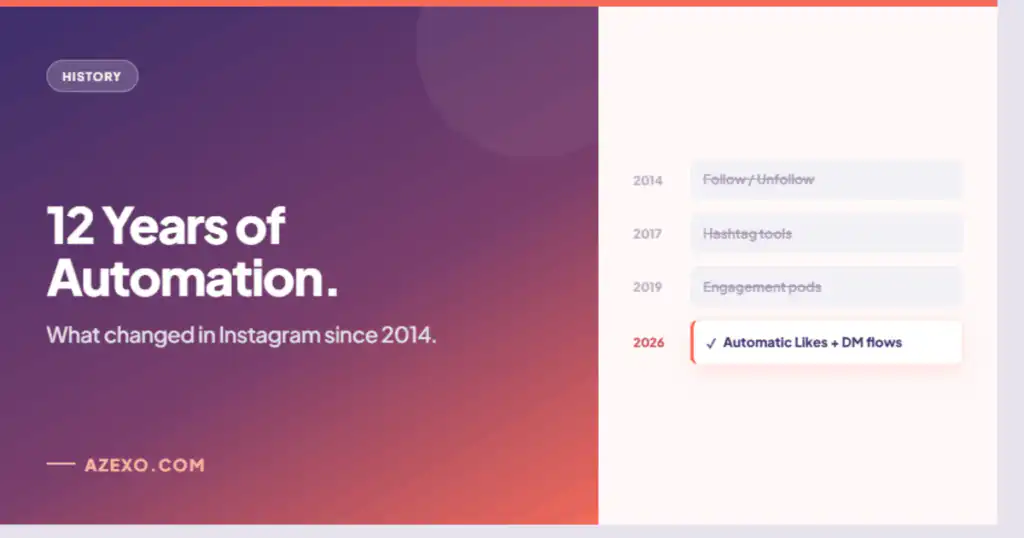
- The follow/unfollow method dominated early Instagram automation but became ineffective as the algorithm shifted away from follower count as a distribution signal
- Hashtag automation was the primary discovery mechanism until 2022, when Instagram confirmed keywords in captions outperform hashtags for SEO discovery
- Engagement pods simulated early signals but degraded as Instagram’s detection systems learned to identify coordinated engagement patterns
- Automatic likes are the form of Instagram engagement automation that has maintained the most consistent value across all algorithm changes since 2014
- DM automation for comment-to-DM flows is the highest-growth automation category in 2026, complementing rather than replacing engagement delivery
2014 to 2017: The Follow/Unfollow Era
When igautolike.com launched in 2014, the dominant Instagram growth automation was follow/unfollow. The logic was straightforward in a chronological feed environment: follow a large number of accounts in your target niche, wait for some to follow back, then unfollow to keep your following count low. Repeat at volume.
The follow/unfollow method dominated the early Instagram playbook. Creators would follow hundreds of accounts in their niche every day and quietly unfollow those who did not reciprocate, a process that was tedious but measurably effective in a chronological feed environment. Today, when someone looks for a service to grow Instagram followers, the expectations look nothing like that, because the platform itself has changed beyond recognition. What worked then was essentially a volume game, and the system was built in a way that rewarded persistent manual effort above almost everything else.
The method died when two things happened simultaneously. Instagram shifted from chronological to algorithmic feed ranking in 2016, which removed the direct connection between following behavior and visibility. And Instagram began actively limiting follow and unfollow rates, eventually implementing API restrictions that made automated follow/unfollow at meaningful scale operationally unsustainable.
By 2019, follow/unfollow was widely understood as ineffective for sustained growth and actively risky for accounts that tried to operate it at volume. The accounts it had built during its effective period frequently had low engagement rates because the followers were not genuinely interested in the content.
2016 to 2022: The Hashtag Automation Period
As follow/unfollow declined, hashtag strategy became the primary organic discovery mechanism. Hashtag research became a science. Users would rotate through tags that were popular in their content niches, experiment with groupings, and identify which clusters reliably got them onto the Explore page.
Hashtag automation tools developed alongside this trend: services that analyzed hashtag performance, tracked which tags were currently yielding Explore placement, and suggested optimal tag combinations. This was a legitimate optimization layer that required no platform policy violations to operate.
Hashtags lost most of their discovery power between 2022 and 2024. Instagram officially confirmed that keywords in captions and profile text are now more effective for discovery than hashtags, which no longer support follows as a growth mechanism. Keywords in captions and profiles are now more effective for discovery than hashtags, which no longer support follows. Hashtag automation tools became less relevant as the signal they optimized for diminished.
2017 to 2021: Engagement Pods
Engagement pods — groups of users who agreed to like and comment on each other’s posts in the first few minutes of publication — became a way to simulate the initial spike in engagement that propelled a post up the ranking. It was a tactic that worked because of Instagram’s design. There was a fairly direct link between frequency and follows to reach, and manipulation of the inputs resulted in certain outputs.
Engagement pods were the manual predecessor to automatic likes services. The underlying logic was the same: seed early engagement to pass the algorithm’s first-window evaluation. The difference was operational: pods required active coordination among members, posting to a group DM or Telegram channel with each new post, waiting for members to engage, and reciprocating on their posts.
The pods degraded as Instagram’s detection systems became more sophisticated. Coordinated engagement from the same small pool of accounts, arriving within seconds of each post across all pod members’ content, produced a detectable signature. The pattern was not what organic audiences produce. By 2021 to 2022, large-scale pods were generating notably less distribution benefit than they had in 2018, and some were producing reach suppression rather than amplification.
2014 to 2026: Automatic Likes
Automatic likes are the category of Instagram engagement automation that has maintained the most consistent value across every platform change since igautolike.com launched in 2014. The specific mechanism has been present across every version of Instagram’s algorithm: posts are evaluated based on early engagement performance, and posts with stronger early signals receive wider initial distribution.
What changed is the weight of likes within the overall signal mix. Instagram now prioritizes active engagement metrics like DM shares, saves, and meaningful comments over older metrics like likes. This shift highlights Instagram’s focus on deeper, more meaningful interactions to drive content visibility.
Likes are now one signal among several rather than the dominant signal. But the early-window evaluation structure that makes automatic likes useful has not changed. The platform still evaluates posts shortly after publication and uses that evaluation to determine initial distribution. Automatic likes still contribute to that evaluation as a social proof seed that influences how organic viewers engage with the content in the same window.
The result is that automatic likes remain effective as a component of an engagement strategy in 2026, but more so when combined with content that earns organic saves and DM shares on top of the seeded baseline. Azexo’s automatic likes subscription addresses the seed layer. Content quality and audience relevance determine what happens in the second and third distribution windows beyond it.
2024 to 2026: DM Automation as the New Frontier
The highest-growth automation category in 2026 is not engagement delivery but comment-to-DM flows. When you add a comment keyword CTA to a post, comment count spikes, DM automation delivers the promised resource, and the DM conversation itself generates a relationship signal that the algorithm uses for future distribution.
This approach works because it generates the signals the 2026 algorithm weights most heavily: conversation depth in comments, DM interactions with followers, and relationship strength between creator and audience. Automated DM delivery triggered by comment keywords is technically permitted under Instagram’s official API as long as it follows rate limits and content policies.
For accounts using Azexo’s automatic likes alongside DM automation tools, the combination addresses both the seed engagement layer (likes in the first window) and the relationship signal layer (DM conversations triggered by engagement). These are complementary approaches targeting different parts of the distribution signal stack.
What Stayed Constant Across Every Era
Across follow/unfollow, hashtag optimization, engagement pods, automatic likes, and DM automation, the constant has been the first-window evaluation structure. Every era of Instagram automation was an attempt to influence what the algorithm sees in the period immediately after a post goes live.
The tools that maintained relevance across the longest time periods are the ones that addressed this mechanism honestly: seeding real engagement from real accounts in a natural delivery pattern. Follow/unfollow addressed it indirectly and stopped working when the signal it manipulated lost weight. Hashtags addressed it through discovery rather than engagement. Pods addressed it directly but degraded under detection pressure.
Automatic likes from real accounts with gradual delivery have maintained relevance because they address the first-window evaluation directly, without creating the detectable coordination signatures that degraded pods, and without depending on a signal that has lost weight as hashtags did. The Engagement Rate Calculator and Instagram Like Counter on Azexo give you the measurement layer to track how these signals interact across your account over time.
Follow/unfollow was the dominant method in 2014 and through 2016. It worked because the chronological feed environment rewarded follow connections directly, and there was a measurable link between follow volume and visibility. The shift to algorithmic ranking in 2016 removed the connection between following behavior and distribution, ending the method’s effectiveness.
Because coordinated engagement from the same small pool of accounts produces a detectable pattern. Pod members engaging with each other’s posts within seconds of publication, consistently across multiple accounts, does not match what organic audiences produce. Instagram’s detection systems identified the pattern and the distribution benefit declined as the detection improved.
Less than they did. Instagram officially confirmed that keywords in captions and profile text now outperform hashtags for discovery. Hashtags no longer support follows as a growth mechanism. They still provide some topical categorization signal, but the era of hashtag optimization as a primary growth driver ended around 2022 to 2024.
Comment-to-DM automation is the highest-growth category in 2026, because it generates DM conversations that carry strong relationship signals in the algorithm. Automatic likes from real accounts remain effective for the first-window engagement seed. The most effective approach combines both: likes seed the social proof signal; DM conversations build the relationship signals that drive long-term distribution.
Because the first-window evaluation structure has been present in every version of Instagram’s algorithm since 2014. The signals the algorithm measures in that window have changed — likes carry less weight, saves and DM shares carry more. But the mechanism itself has not: posts are evaluated early, and the evaluation determines initial distribution. Automatic likes that seed the early signal have remained relevant throughout.
The Automation That Has Held Up Since 2014
Real-account delivery. Gradual pacing. First-window detection. Built on igautolike.com infrastructure — refined through every algorithm change.
View Plans No contract · Cancel anytime · No password required