
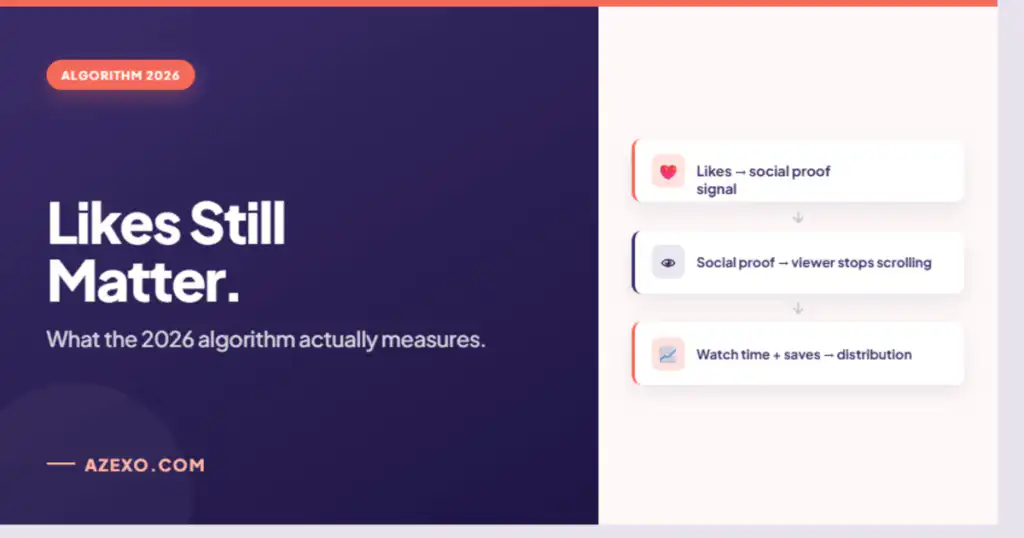
- Likes lost weight as a direct distribution signal in 2026 but retained their role in social proof, which drives saves and shares
- Instagram’s 2026 algorithm rebalanced toward DM shares, saves, and watch time as primary distribution signals
- Social proof and algorithmic performance are not separate systems, they are interconnected through the engagement behavior that visible likes influence
- Posts with stronger engagement velocity still receive wider distribution even after the algorithm rebalancing
- The first-window evaluation window remains real, and likes that arrive in that window still contribute to whether a post gets expanded distribution
What Actually Changed in 2026
Instagram’s algorithm rebalanced significantly in early 2026. The shift was confirmed across multiple sources including direct commentary from Adam Mosseri. The platform moved weight away from likes and follower count as distribution signals, and toward DM shares, saves, watch time on Reels, and profile clicks.
That is the accurate description of what changed. It is not, however, the same as saying likes no longer matter. The rebalancing changed their weight in the distribution ranking model. It did not remove them from the engagement ecosystem.
Posts with stronger engagement velocity still receive wider distribution. More likes create social proof, and social proof increases additional engagement from real users. The mechanism is indirect now rather than direct. Likes trigger social proof behavior in viewers, and that social proof behavior produces the saves and shares that the algorithm weights most heavily.
The Social Proof Chain: How Likes Generate Saves and Shares
Social proof is not a branding concept. On Instagram in 2026, it is a behavioral mechanism that connects visible engagement to algorithmic performance.
Social proof and algorithmic performance are not separate systems that operate independently. They are deeply interconnected through the engagement behavior that social proof influences. When content carries strong social proof signals, viewers are more likely to engage with it. When more viewers engage, Instagram’s distribution system receives stronger engagement signals. When engagement signals are stronger, the algorithm distributes content more widely.
The specific behavior this describes: a viewer who opens Instagram and encounters a post with 200 likes and 15 comments is more likely to stop scrolling than a viewer who encounters the same post with 3 likes and 1 comment. That increased stop rate produces more watch time. More watch time produces a higher completion rate. More completions produce more saves and shares. More saves and shares produce wider distribution.
Likes are the visible signal that triggers the beginning of that sequence. They are not the end signal the algorithm acts on. But removing them from the sequence does not improve the outcome.
Why the First-Window Signal Still Matters
Instagram evaluates posts in a series of windows beginning at publication. The first 20 minutes determine initial distribution. Posts that fail this window rarely recover in later ones.
Likes that arrive in that window contribute to the overall engagement picture the algorithm evaluates. They are one input among several. Saves and DM shares carry more weight in 2026 than they did in 2023. But the first-window evaluation still looks at the combined engagement signal, and a post with zero visible engagement in the first 20 minutes is starting from a worse position than one with a credible like count.
This is where Azexo’s automatic likes subscription addresses a specific problem. The subscription detects new posts within approximately 60 seconds and begins delivery before the first window closes. The engagement arrives when it has distribution impact, not two hours later when the window has already run.
What Brands Actually Observe About Like Counts
The practical observation that any brand running product posts on Instagram can make is straightforward. A product image with 200 likes converts differently than the same image with 3 likes. That is not an algorithm effect. That is a human psychology effect.
When an individual is viewing a post on Instagram and there are thousands of likes, they will automatically believe that the material is good and worth following. The psychological mechanism is social proof: people take visible engagement as a proxy for content quality and trustworthiness.
For e-commerce brands, this produces a measurable outcome. Engagement on a product post signals to potential customers that other people found the product worth engaging with. That signal affects purchase consideration. It is the same principle that makes high review counts on a product page convert better than a product page with two reviews, even when the individual review quality is identical.
Likes are a form of that review count. They are publicly visible engagement from other users, and they influence how new viewers evaluate the content and the account behind it.
The Accounts That Benefit Most from Consistent Like Counts
Not every account gets the same value from likes in 2026. The accounts where visible engagement has the most impact share a few characteristics.
E-commerce brands. Product posts live or die on social proof. A post with strong like counts signals established demand. That signal affects both algorithmic distribution and human purchase behavior. Both matter for conversion.
Accounts building credibility in competitive niches. When a new viewer encounters an account for the first time, the visible engagement on that account’s content is part of how they evaluate whether to follow. An account with consistently low engagement looks less established than one with a credible and consistent like count, regardless of content quality.
Creators posting outside peak hours. The organic like count on an off-peak post is lower than the same content posted at peak because fewer followers are online to engage in the first window. Automatic likes address that timing disadvantage by ensuring first-window engagement regardless of when the post goes live.
This is why services in this category, including Buzzoid, StormLikes, GetAFollower, and Azexo’s buy Instagram likes option for one-time orders, continue to operate in a market that understands the algorithm has shifted. The shift changed how likes feed into distribution. It did not change how likes influence viewer behavior. And viewer behavior is what produces the saves and shares that distribution now depends on.
Indirectly yes. Likes lost weight as a direct distribution signal, but they contribute to social proof, which influences viewer behavior. When viewers engage more because of visible likes, that engagement produces saves and DM shares, which are the signals that drive distribution in 2026.
DM shares, saves, watch time on Reels, and profile clicks now carry the most algorithmic weight. Instagram confirmed this shift in early 2026. Likes still contribute to the early-window engagement signal, but they are one input among several rather than the primary driver.
Through social proof. When a viewer sees a post with visible engagement, they are more likely to stop and watch it. Watching produces higher completion rates. Higher completion rates produce more saves and shares. Likes are the visible signal that starts that chain, even though the algorithm acts on the downstream behavior rather than the likes themselves.
Yes. For e-commerce content, visible engagement on a product post signals established demand to potential customers. That signal affects purchase consideration independent of algorithmic distribution. A product image with 200 likes converts differently than the same image with 3 likes, and that difference is human psychology rather than an algorithm effect.
It depends on the account and the goal. For accounts where social proof has conversion impact, brand credibility matters, or consistent first-window engagement is hard to achieve organically, likes from a real-account service delivered gradually still serve a function. They are less useful as a standalone growth mechanism than they were in 2019, and most effective when combined with content that earns organic saves and shares on top of the seeded engagement.
Consistent Likes on Every Post, Before the Algorithm’s First Window Closes
Real accounts. Gradual delivery. 60-second detection. Built on igautolike.com infrastructure since 2014.
View Plans No contract · Cancel anytime · No password required